
HHow do I start production using Supercritical Fluid extraction (SKE)?
The growing demand for natural extracts obtained with the help of environmentally friendly technologies contributes to the growing popularity of SKE. However, due to the high setting of the process parameters, the SCE requires optimization, which at first may seem difficult. Therefore, we have presented here the main steps necessary to develop and scale the CCE process. First, let's start by listing just a few applications of supercritical fluids:
- Extraction (bio)active ingredients from natural products
- Extraction of oils and active substances from medicinal and aromatic plants
- Extraction of algae and phytoplankton
- Propolis extraction
- Oil extraction from oilseeds
- Extraction of fatty acids from natural oils (e.g. fish oil)
- Extraction of useful substances from food waste (e.g. after cold pressing)
- Extraction of vitamins
- Production of natural cosmetic raw materials
- Production of food additives and over-the-counter raw materials
- Production of natural dyes (pigments)
- Sterilization at high pressure
- Decaffeination of coffee and tea
- Partial degreasing of food products
- Removal of nicotine and tar from tobacco
- Aerogel drying
Advantages of CO2-based CCE:
- CO2 is available, non-toxic, and non-explosive
- Eliminates the risk of oxidation of the extract due to oxygen displacement
- Evaporates completely after extraction
- Has a relatively low supercritical threshold
- Easily recoverable for repeated use
- Allows flexible control over extraction by changing pressure, temperature, current velocity, and other parameters
- The solvating ability can be further enhanced by the addition of co-solvents such as ethyl alcohol
Stage 1 – Laboratory tests (Series F)
Этап 1 – Лабораторные исследования ( Серия F)
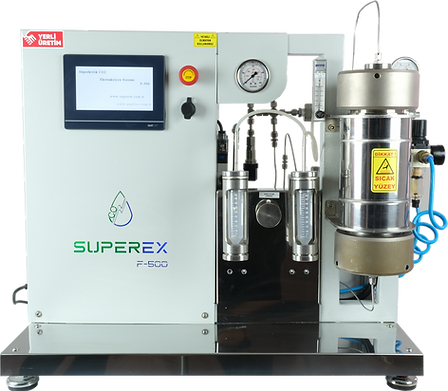
Choosing specific industries as consumers of an extraction product requires knowledge about its chemical composition. Thus, the initial development of the process involves determining the optimal temperature, pressure, flow rate and other extraction conditions under which the primary extract with the most desirable chemical composition and/or the highest yield is obtained. This is achieved by conducting a series of extractions using either the classical trial and error method or a statistical approach to experiment planning (DOE) followed by chromatographic and other analysis of the extracts obtained. Such studies will evaluate the extraction capability of target chemical components using supercritical CO2 and/or the need for a co-solvent to facilitate/accelerate extraction or improve yield. Such initial studies are possible using our F-500 laboratory extraction system, designed specifically for laboratory studies. For these studies, we have a unit with a 500 ml extractor-reactor volume, the Superex F-500, which stands out for its compact and bench-top design, easy sample loading and retrieval, easy cleaning and affordable price. The cleaning procedure is usually performed using ethyl alcohol or hot water, feeding the system with CO2 (carbon dioxide) and creating pressure to clear the pipelines. The F-500 can extract both liquid and solid raw materials, but is most often used for working with dried and ground plant material - for liquid raw materials, we have a specially designed countercurrent extraction system, the F-1000.
Thus, with a Superex F-500 system, you can test as many different raw materials as you want with a small investment and determine the planned product and extraction parameters. The F-500 accepts on average up to 40% leaf, dry, crushed raw materials and 80-85% oil raw materials (e.g. seeds) by volume. For example, 200 grams of dry crushed lavender leaves or 400 grams of black cumin seeds can be loaded into a 500 ml extractor column. These proportions are similar for other supercritical units.
Stage 2 – Advanced Lab Testing (SC Series)
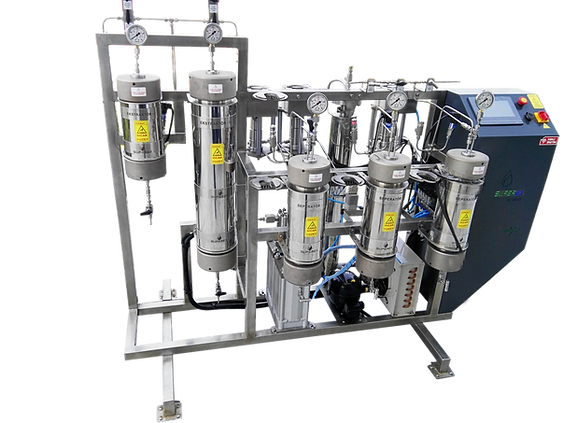

Our SC series of laboratory extraction systems can be considered a fully functional counterpart to our full-scale production systems. These systems feature pressure and/or temperature adjustable separators and higher flow rates than the F-500, allowing for significantly faster extraction times. For example, lavender can be extracted in as little as 45 minutes with the SC system compared to 90-120 minutes with the F-500. SC systems are available with 1, 2 or 5 L extraction vessels and feature a CO2 recirculation system with 85-95% efficiency, reducing operating costs and contributing to the sustainability of the process. In addition, the addition of separators allows for fractionation of the extract by controlling the solvating power of the supercritical CO2. As the pressure and/or temperature in each separator is successively reduced, components of the extract with progressively lower molecular weights are released from solution into the separators – this is due to their decreasing solubility along with the density of the CO2 as the pressure decreases. Thus, a 3-separator system can collect 3 fractions of the extract, each characterized by a progressively decreasing average molecular weight. This fractionation can be optimized using a DOE approach in combination with chemical composition studies to obtain final extract(s) rich in the target component(s).
Stage 3 – Small and medium scale pilot production (P Series)
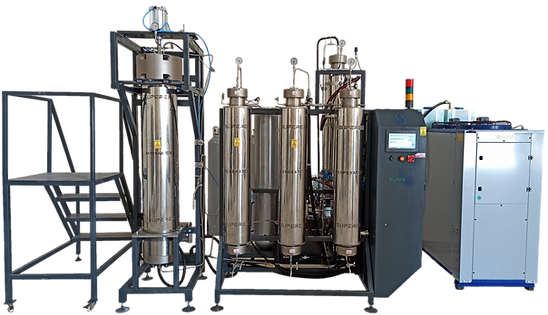
With our P-Series units, you can achieve production volumes and assess the market share of your products while focusing on production and branding. For example, the P-30 system with dual extractors (30+30L) allows you to process 150 to 250 kg of dried and ground material per day. Pilot production will also determine the maximum pressure and temperature required for your chosen process, allowing you to finalize the process development and prepare for final scale-up. For example, if your process requires only 260 bar, the corresponding full-scale industrial system will be significantly cheaper than a 345 bar system due to the use of optimized extraction vessels and high-pressure pumps. For continuous extraction and time savings on pressure reduction and raw material changeover, we recommend purchasing a system with dual extractors, which allows loading/unloading of raw materials during the extraction process. If you work with several types of raw materials, we also recommend purchasing several systems to save time on cleaning when changing raw materials. This is especially relevant for pharmaceutical, cosmetic and other industries requiring high purity.
Stage 4 – Full-Scale Industrial Production
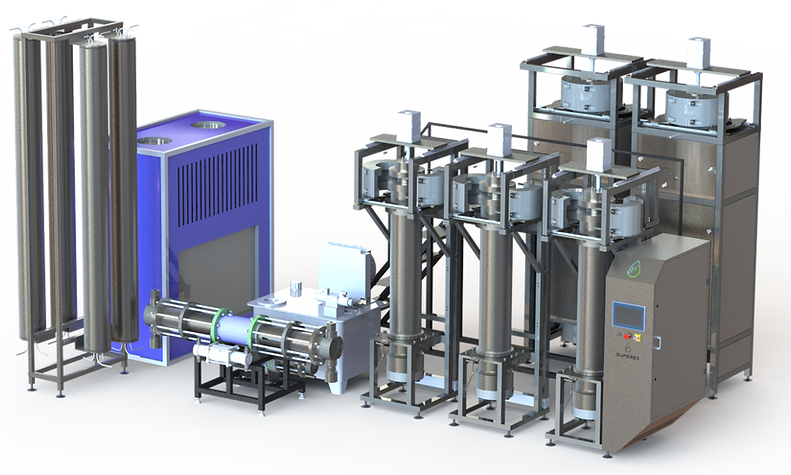
Industrial scale SCE is rapidly expanding due to the growing demand for high-tech and environmentally sustainable extraction processes. A full-scale industrial system has virtually unlimited processing capacity (1000 L or more) and typically must be tailored to the requirements of each individual process due to the high costs. Therefore, to justify the investment and operate an industrial scale plant efficiently, an optimized SCE process and at least one product ready for scale-up to the market are absolutely essential. This is why we recommend the step-by-step approach to SCE described above. Once you are ready to use an industrial scale system, our team of experts will be happy to design a custom system for your specific needs.